
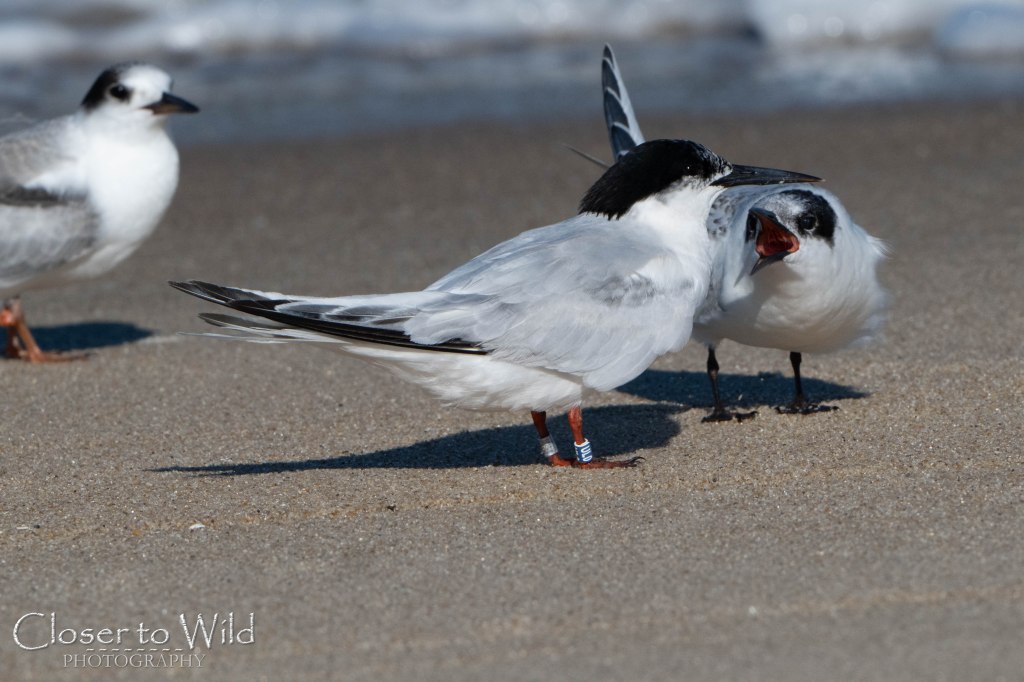
Lifer #402 – Roseate Tern. These birds are rare in NJ compared to their cousin, the aptly named Common Tern. In a flock of over 100 Common Terns, I found just these two. There are only a few subtle differences in appearance that make it challenging to tell them apart:
(1) Body color: the Roseate is a lighter gray than the Common, although the shade of gray varies in both species, and in the bright sunlight some Commons can appear quite pale; (2) Bill color: the adult Roseate has a black bill, while the Common’s bill is mostly orange/red with a black tip. But the amount of black on the bill can vary, and this time of year when they are transitioning to winter plumage, Common Terns can have an all-black bill; (3) Bill length: the Roseate has a slightly more slender bill than the Common, but, again, there is variability; (4) during breeding season, Roseates have a faint pink hue to their belly, which they don’t have this time of year; (5) Tail feathers: Roseates have long tail streamers that extend past their wing tips when perched. But tail feathers can break or fall out during molting, and in fall/winter they may be missing altogether.
So you can see my dilemma? I couldn’t really point to any defining characteristic at the time, but this bird stood out to me from the start. I noticed it almost right away, but I wasn’t sure why. I spent 4 hours looking at every bird in this flock, but this was the one I kept coming back to. The characteristic that stood out to me the most was the white scalloped edges on the wingtips, but I didn’t see this mentioned in any books or online descriptions.
I didn’t know it at the time, but the blue band on its leg with the white letters ‘ULD’ identify this definitively as a Roseate Tern.
 Closer to Wild
Leave a comment